The Maßkrug: Tradition and Evolution of a Bavarian Cultural Heritage
News News blog
The Maßkrug is far more than just a drinking vessel—it embodies Bavarian beer culture and tradition. But what lies behind this iconic mug, and how has it evolved over the centuries?
History of the Maßkrug: From Standard to Cultural Heritage
The Maßkrug originated from practical considerations. “A Maß” originally referred to a standardized unit of volume for wine and beer. Until 1811, a jumble of different measures prevailed in Bavaria—in Würzburg, for example, a Maß held 1.17 liters. King Ludwig I put an end to this confusion and standardized the Bavarian Maß at 1.069 liters.
A decisive change took place in 1869: Bavaria abolished the Maß in favor of the metric liter. Nevertheless, it remained in use in practice. It wasn’t until 1885 that manufacturers switched their mugs to the new one-liter standard.
Materials: From Clay to Glass
At the end of the 19th century, the production of beer mugs underwent a revolution. The traditional clay mugs, also known as “Keferloher,” were increasingly replaced by glass versions. This change brought a decisive advantage: guests could now tell at a glance whether the mug had been filled correctly.
Clay beer mugs have retained their place, however. In Franconia and among connoisseurs, they are considered superior because they keep the beer cool longer. Many clay mugs have pewter lids, for which there is a characteristic notch on the handle.
Modern beer mugs: Design meets function
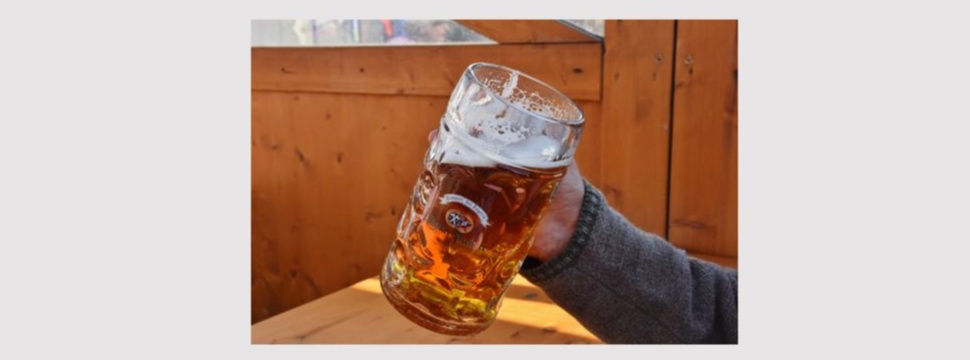
Today’s glass beer mugs, also known as “Augenkanne,” feature a well-thought-out design. The “eyes”—flat, round indentations—give the glass stability and an appealing look. Contrary to popular belief, they do not serve as anti-slip protection when clinking glasses.
The calibration mark has changed: Traditionally, the groove above the eyes served as the calibration mark. Since 2015, the Measurement and Calibration Act has required a separate calibration mark located approximately 3 mm above the groove.
Distribution: Bavaria and Beyond
Measuring mugs are primarily found in Bavaria and Austria. There, they are used not only for beer but also for beer-based mixed drinks such as Radler or Goaßmaß, as well as alcoholic specialties like Schneemaß or Laternmaß.
Usage: Not Just for Beer
Historically, the Maß served as a measure for both wine and beer. While beer is the predominant use today, in Bavaria and Austria, Maß mugs are still filled with a variety of beverages.
Conclusion: A Living Tradition
The Maß mug combines tradition with modernity. From its earthenware origins through legal reforms to today’s design standards, it reflects Bavarian culture. Whether at Oktoberfest or in a local pub—the Maß mug remains a symbol of community and enjoyment.